Saturday, September 12, 2015

Charles Emerson Griffin In Coalville


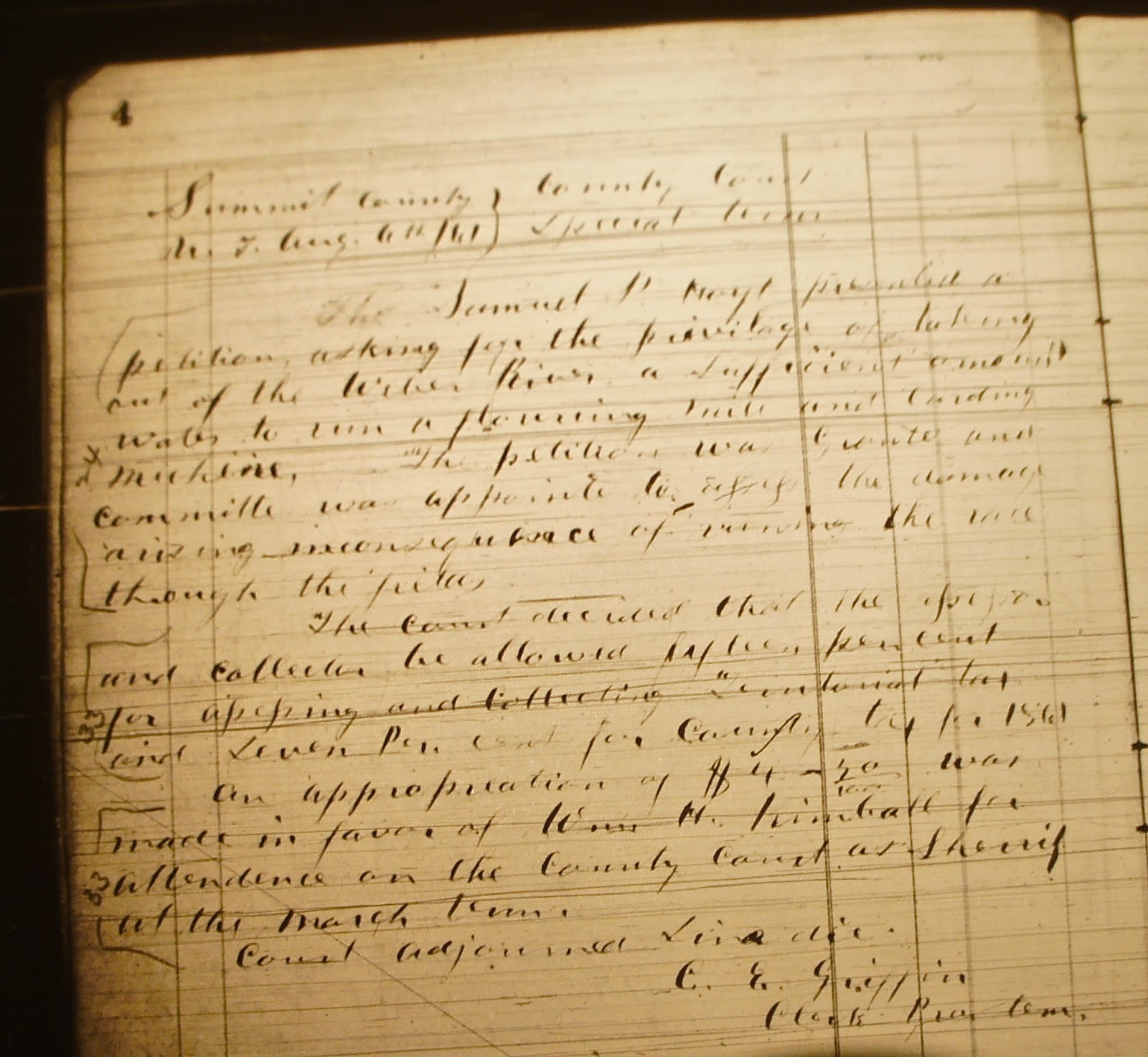
Charles’ first foray into Summit County was in 1860. By 1861 the County had begun to attract enough interest that the State Legislature appoint a Probate Judge to supervise the organization of the County. William Vance, the new Judge, selected Charles E. Griffin to serve as his Clerk Pro Tem and manage the affairs of the newly seated court.------
One of the first offices to be filled by the new court was that of Assessor and Tax Collector. The Judge appointed Charles to serve in that role the first to hold the office in Summit County.--------
The first hint we get that Charles was also appointed and later elected, as County Surveyor was the notice of his registration from the position logged into the county records.--------
The early Summit County historians made note of the large number of hats that Charles wore and marveled at how he jugged his multiple responsibly. In addition to everything else he was involved with we also find a note that indicates he was deeply involved with the irrigation system.


Tuesday, July 21, 2015

Documentation for Varney Histories


1- Probate record for Joseph Austin, which lists his wife as Sarah (Starbuck).
2-Deed record that lists 3 of the children of Joseph and Sarah Austin.
3-Deed that lists Peter Varney and his first wife Elizabeth (Evans).
4- Deed that lists Moses Varney and his parents Benjamin Varney and his mother Martha Whitehouse. Martha Tibbets/Varney married Edward Whitehouse on the death of Benjamin Varney.
5- Deed lists Phebe daughter of Benjamin Varney.
6-Edward Whitehouse and Moses Varney.--------

Stories posted on the-Samuel Griffin Genealogy Blog- web site.


Sunday, July 12, 2015

Black Hawk War


Charles Emerson Griffin wrote, “Soon after I got to Long Valley the settlers met together and organized themselves into a military company and I was elected Adjutant of the company. The company was attached to Colonel Wm Maxwell’s regiment.”
Charles’s short stay in Long Valley was dominated by the events of the Black Hawk War. The patrol led by Captain James Andrus that included Sargent Charles E Griffin was probably the most prolonged engagement in the Southern Utah portion of the war.
The war atmosphere was felt everywhere in the Territory. Most  communities had made preparations for the eventuality of war but, it was not until the raid at Pipe Springs, that resulted in the death of Whitmore and McIntyre, that the reality hit home. As shown in the MUSTER ROLL units were quickly dispatched to Pipe Springs in response to the news of the deaths. The first units out managed to recover the bodies of the dead men.
Subsequent to that we see a flurry of correspondence concerning GATHERING THE ANIMAL HERDS and such other steps that may aid in the defense of the scattered communities. We also see a flurry of CORRESPONDANCE between the Nauvoo Legion chief of staff, George A. Smith, and the Legion commander, Daniel H Wells. The number one topic at the time was the raids in Southern Utah and the status of the unit led by Capt. Andrus that was tasked with tracking down the raiders and protecting the far-flung ranches.
The MUSTER ROLL for the Andrus/Griffin patrol included a synopsis of the action written by Capt. Andrus. Charles’s name is partially hidden in a fold in the document. We have ENLARGED selected portions of the document including the notation that he took 2 horses, 1 rifle, 2 pistols and a sword. Later that year another MUSTER ROLL was written at the headquarters of General Lorenzo Snow, which also contained a brief description of the campaign.
Associated with many patrols during the Black Hawks War we see records of the REQUESITIONS for supplies.
As the summer of 1866 wore on it became evident that the small communities scattered across the Utah/Arizona border were indefensible so steps were taken to move them to safety. ORDERS were issued for militia support. The Griffins in Long Valley moved to Kanarraville where we see Albert Griffin joining the MILITIA. Click on images to enlarge.


Friday, July 10, 2015

Charles E. Griffin Utah War


“On the 14th of Aug. 1857 I was in the City and received notice to be at the Tithing Office that night armed and equipped for a campaign. I did not enquire where. I returned home, saddled my horse, took my gun and blankets, that being all the arms I then had, and returned to the City where I found the company assembled. We camped there that night and the next morning, the 15th of August 1857, we started East.”
The tensions between the Mormons and the outside world had been slowly building up. In response the leadership of the Nauvoo Legion had issued ORDERS to all of the counties in the Territory to increase their military preparedness. Word of Johnson’s Army leaving Fort Leavenworth, Kansas reached the Salt Lake Valley on July 24th. On August 15th the ORDER sending Charles E, Griffin and his fellow soldiers East to face the oncoming Federal Army was issued. A unit in Provo received a similar ORDER.
Charles wrote that he left home with a single “gun”. However weapons and SUPPLIES were quickly forwarded to the Cavalry units manning the front lines. The most sought after weapon for the cavalry units was the COLT DRAGOON six shot, cap and ball pistol. Charles was to carry such a weapon during much of his military service.
As the situation became more intense MARTIAL LAW was imposed throughout the Territory.
One of the interesting aspects of the Utah War was the correspondence between Col. Alexander, the Federal Commander, for much of the campaign and Brigham Young. In these LETTERS each stakes out their opposing point of view.
The Life Guards made a rapid trip from the Salt lake Valley to the area near Devils Gate. One of the first major milestones was crossing the ridge before dropping down into the Bridger Valley. From the TOP OF THE RIDGE the view is toward Fort Supply a view Charles would have taken many times before the campaign was over. All that remains of Fort Supply is a beautiful MEADOW.
As the Life Guards retreated before the oncoming Federal Army they would have made many crossings of the Sweetwater River like the one named 6TH CROSSING.
SOUTH PASS was the single most significant point on any crossing of the Oregon Trail. Just after crossing South Pass you find PACIFIC SPRINGS the sight of the first major confrontation between the opposing forces.
As the Life Guards retreated across Wyoming they did everything they could to deny the Federal Army the resources the land had to offer to support the men and their animals. One of their last acts was to burn FORT BRIDGER with its tall rock walls in order to deny its use to the Federal Army.
Unable to make it into the Salt Lake valley that year the Federal Army was force to go into winter quarters at FORT SCOTT just south of Fort Bridger.

The records for the Utah War were kept separately from the rest of the military archives. Here are a few surviving MUSTER ROLLS from the Life Guards. By the end of the campaign Robert T. Burton was commanding some 300 men.